
The Unique Cosworth Story
The help of Michael Costin in this section is gratefully acknowledged.
Any remaining errors are the author’s responsibility.

Eg 47 1968 Cosworth DFV 2987cc; 415 HP @ 9,500 RPM, (see Note 75B) Eg 62 1982D Cosworth DFV - Judd; 2987cc; 515 HP @ 11,300 RPM
The Cosworth DFV ('Double Four Valve') Grand Prix engine was unique in three areas:-
- Racing successes
- Value-for-purchasers' money
- Commercial return to its makers.
It is unlikely ever to be surpassed in any of these ways.
Over 16½ years, from a victorious June 1967 debut to the end of 1983, without change of bore and stroke or major castings, it powered nine men who won 12 Drivers' Championships* and five chassis makers who won 10 Constructors' Championships**. It won for its users 154 classic Grand Prix victories, 65% of the possible, competing against 10 other major engine makes with 30 substantially different specifications. (see Note 75)
The 3L normally-aspirated DFV was only displaced eventually by TurboCharged (TC) engines of 1.5L (the alternative regulation limit for pressure-charging), although a respectable argument existed that pressure-charging by that method breached a basic rule that only one engine per car was permitted. (see Note 76) The TC engines required five years of development in the Grand Prix application before they conquered the DFV finally in 1983 to win both Championships.
For ease of study these 16½ years are treated together and the Ferrari engines which interrupted the DFV's successes will be described later.
* G Hill, Stewart (3 times), Rindt, Fittipaldi (2 times), Hunt, Andretti, Jones, Piquet, Rosberg. The first and last Championships are listed in the heading above and in later details an Eg number indicates both Championships were DFV-powered except where shown as D for Drivers' only (1976 and 1982).

.jpg)
The General Design of Racing Piston Engines
The “engineering art” of piston engine design can be summed up in three words:-
Inspiration; Calculation; Experience
and the art lies in knowing how to mix these so that the resultant engine “Breathes, Burns and Turns” efficiently and goes on turning for the required life.
Many men have designed the engines given in this review over 1906 - 2000, which covers for each racing year the selected “Car-of-the-Year” (CoY).
From 1906 to 1934 inclusive the CoY selected Is the winner of the Grand Prix de l’Automobile Club de France. From 1935 to 1949 inclusive the CoY is the winner of most GPs in each season. Beginning with 1950 the CoY is the mount of the winner of the Formula One Drivers’ Championship which began in that year.
If the winner of the Formula One Constructors’ Championship, which began in 1958, was different that make is also counted (shown as C).
With diffidence a list is given of those significant in the engine design and development of these selected CoY. “With diffidence” because it is extremely hard to know from the outside of an organisation and at a great time interval who was really the main driving force in any project (a notable exception is Keith Duckworth and the Ford Cosworth DFV).
At least it can be said that, if those named were not that main force, they took a large share of the responsibility. On this subject of responsibility, an anecdote dated just after WW1 may be recounted appropriately:-
someone asked the retired Marshal Joffre (French Commander-in-Chief 1911 – 1916) the tactless question “Which General really won the Battle of the Marne”? (a 1914 turning-point of WW1 in favour of the French, the conception of which was much disputed). His reply was “I do not know who won that battle but, had it been lost, I know who would have been blamed!”
With the reservation mentioned
the designers
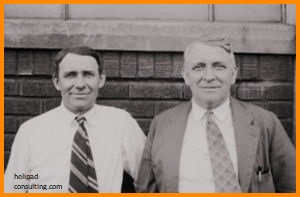
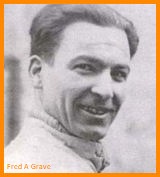
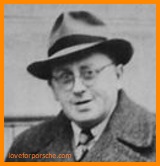
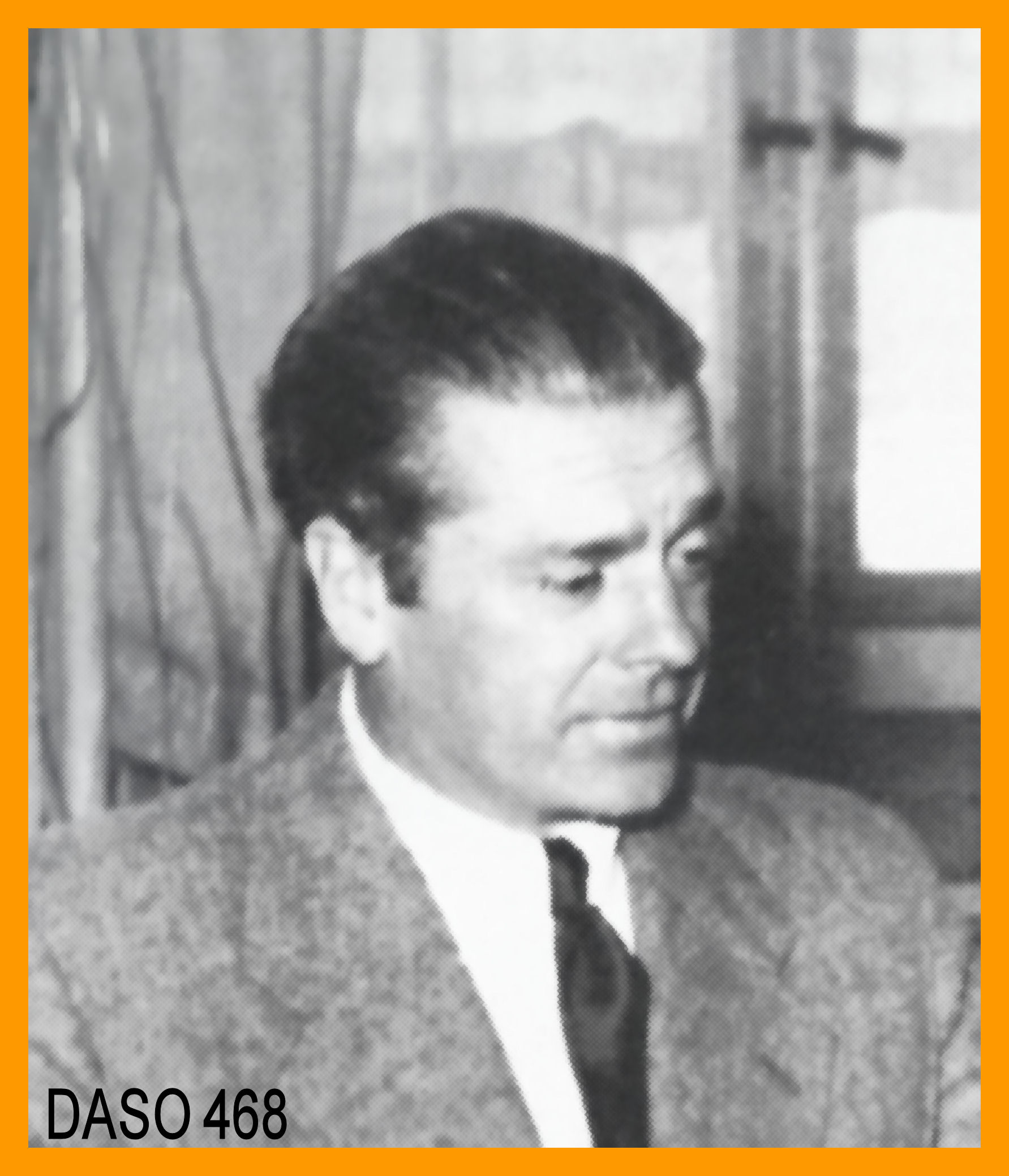
of the CoY are listed below, with portraits of some of the most famous. As will be seen, some men designed more than one successful engine.- 1906 Louis Renault Renault
- 1907 Unknown FIAT.
- 1908, 1914 Paul Daimler
Mercedes. - 1912,1913 Ernest Henry Peugeot
- 1921 Frederick Duesenberg (RHS) with Augie Duesenberg.
- 1922 Guilio Cappa FIAT.
- 1923 Walter Becchia & Vincenzo Bertarione Sunbeam.
- 1924, 1932, 1934
.jpg) Vittorio Jano Alfa Romeo
Vittorio Jano Alfa Romeo - 1925 Charles Planchon &
- 1925,1927 with Albert Lory Delage
- 1926,1928 to 1931
Ettore Bugatti
Bugatti - 1933 Ernesto Maserati Maserati.
- 1935 Hans Nibel & Albert Heess Mercedes-Benz.
1936 Ferdinand Porsche, Karl Rabe (above), & Josef Kales Auto Union.- 1937, 1938, 1939,
Fritz Nallinger & Albert Heess,
Development: Rudolf Uhlenhaut Mercedes-Benz. - 1948 Gioachino Colombo &
- 1948, 1950, 1951 with Orazio Satta Alfa Romeo.
- 1952, 1953 Aurelio Lampredi (below LHS) Ferrari.
- 1954, 1955 Fritz Nallinger (LHS) & Hans Scherenberg
- 1954, 1955
Hans Scherenberg & Hans Gassmann.
Development:
Rudolf Uhlenhaut
Mercedes-Benz - 1956 Vittorio Jano & Ettore Mina Lancia-Ferrari.
- 1957 Gioachino Colombo & Guilio Alfieri Maserati.
- 1958 Vittorio Bellentani (& Gioachino Colombo) Ferrari.
- 1958C Frederick Fox, Eric Richter & Leo Kuzmicki Vanwall.
- 1959, 1960, 1963, 1965, Walter Hassan RHS (& Harry Mundy LHS for basic FPE design). Later development Peter Windsor-Smith Coventry Climax.
- 1961, 1964 Carlo Chiti Ferrari
- 1962 Peter Berthon (RHS above) & Aubrey Woods (LHS below). Development Anthony Rudd (RHS below) BRM.
- 1966, 1967 Philip Irving & Frank Hallam (RHS). Development: John Judd Repco.
- 1968 to 1974,1976, 1978, 1980 - 1982 Keith Duckworth (RHS) Development: Michael Costin. Also John Judd. Cosworth.
- 1975, 1976C, 1977, 1979, 1982C, 1983C Mauro Forghieri Ferrari.
- 1983 Paul Rosche BMW.
- 1984, 1985, 1986 Hans Mezger Porsche (TAG).
1986C, 1987, 1988 1989 to 1991 Eiji Taguchi (below), Development Osamo Goto
(LHS) Honda.

1992, 1993, 1994C, 1995 to 1997 Jean-Jacques His (below) & Bernard Dudot (LHS) Renault.
- 1994 Nicholas Hayes Cosworth.
- 1998, 1999 Mario Illien Ilmor.

1999C, 2000
Paolo Martinelli (LHS) & Gilles Simon (below)
Ferrari.

.jpg)
.jpg)





 1949 Gioachino Colombo (below RHS)



.jpg)
about the technical factors involved in :- The General Design of Racing Piston Engines.


Welcome...
The author of this automotive website also has a strong interest in general history. A new website named Strategy in History has been produced to put into public access some papers written in that area. Visitors here with similar interests may like to access this site.
This engines website includes at Appendix 8 and Illustrations for Appendix 8 details of Aero Piston Engines. One of these was the Rolls Royce 'R' type racing engine developed for the 1929 and 1931 Schneider Trophy seaplane competitions. The way in which this was the foundation of the famous Merlin fighter and bomber engine so vital to the Allies winning WW2 is described in the "Strategy in History" website at Contribution No. 10 with the title:- A short video of the 1931 S6B flying round the Solent racecourse to win the Trophy is included here, with the exciting sound of a 36.7 litre V12 at full throttle and 3,200 RPM! This is the 66th addition (22nd August 2022) to a website which is not a commercial project, and which has now been running for 12 years. The format basically provides analyses of the engines for 'Grand Prix Cars-of-the-Year' (CoY) from 1906 to 2000. Motor-cycle data is also included. Many items have been added which are post-2000. For these please consult Notes 13 Part 1/A,108,108B,111,112,119,120,121,129 (see list at end of Contents) and Corrections and Additions at PP 1,7, Note 13 Part II at P.10,17,31,44 and 69. Checking on this will give links to the selection. _________________________________________________ Overview & Analyses The 49th enlargement used the latest data to provide the following:- These 3 sections are a set which should be read consecutively. Chart A1, from the Analysis UPDATE Part 2, gives a general look overall using the Parameter ECOM (see below) of the basic review 1906-2000, plus some added information on 2001-2018. Efficiencies Combined Efficiency (ECOM) is defined in an Addendum to the The details for the engines are given in Appendix 1 under row 130. The Contents section below gives links to these Eras and to various general chapters on racing engine design and development. Recently 4 new Appendices have been added to the site (see Contents):- Each of these Appendices has associated ILLUSTRATIONS _________________________________________________ Visitors should consult CORRECTIONS & ADDITIONS and also CORRECTIONS & ADDITIONS PART 2 for the latest data on some entries where an index is provided for Engines (P.i) and another for Subjects (P.ii) to help locate changes. _________________________________________________ The 37th enlargement added a new section:

1st Naturally-Aspirated Era (1NA)
Sheets 1 and 2
Sheets 1 to 5
There have been recent enlargements which have contained the following items, all linked here: _________________________________________________ The 61st enlargement added:- _________________________________________________ The 62nd enlargement added:- _________________________________________________ The 63rd enlargement added:- _________________________________________________ The 64th enlargement adds:- _________________________________________________ The portraits of the Designers in the sidebar are extended to show many more men involved in the 'Car of the Year' which is the core of the website
Appendix 1 is now fully updated with the changes. It includes the Weight Function (WF) on line 138.
_________________________________________________
Visitors' attention is drawn to the section
Grand Prix Motorcycle Engine Development, 1949 - 2008
Other motorcycyle data is given in
- Appendix 7 and Illustrations for Appendix 7
- Note 92, Note 118 Part 2 P.9, Note 120, and Note 138
- and CORRECTIONS & ADDITIONS AT PP 7, 28 AND 31.
- Note 92, Note 118 Part 2 P.9, Note 120, and Note 138
_________________________________________________
A general thesis linked to Note 66 and Note 124 (see below) is also accessible here as a Natural Rule of Thumb.
_________________________________________________
The Contents of the whole review are as follows:
- Foreword
- Introduction
- The Sporting Limits - Major rules controlling engine design
- Short Glossary of Abbreviations
- Overview of Performance UPDATE;
- Analysis of Overview of Performance UPDATE;
- General Review:
- The Design Eras in detail;-
- Preface
- 1st Naturally-Aspirated Era (1NA) 1906-1923: Egs. 1 to 9;
- 1st Pressure-Charged Era (1PC) Part 1, 1924 - 1939; Egs. 10 to 25;
- also Part 2, 1948 - 1951; Egs. 26 to 29;
- 2nd Naturally-Aspirated Era (2NA)
- Part 1 1952 - 1957, Egs. 30 to 35;
- Part 2 1958 - 1960, Egs. 36 - 39
- Part 3 1961 - 1965, Egs. 40 - 44
- Part 4 1966 - 1982, Egs. 45 - 62
- Eg. 47 The Unique Cosworth Story;
- 2nd Pressure-Charged Era (2PC) 1983 - 1988, Egs. 64 to 68;
- Egs 69,70,71 Honda RA166E,RA167E, RA168E,
- with power curves and fig.70A and figs. 71A,71B
- 3rd Naturally-Aspirated Era (3NA) 1989 - 2000 (end of review): 12 years
- Part 1 1989 - 1994, Egs. 72 - 78; The 3.5 Litre Formula
- Part 2 1995 - 2000, Egs. 79 - 85; The 3 Litre Formula Eg. 84 Ferrari 048 and Eg. 85 Ferrari 049
- Statistics of the "Car of the Year" (CoY) makers
- 'Significant Other' Engines:-
- 'A Century of Grand Prix Engine Weights, 1906 - 2005'.
- Analysis UPDATE, Parts 1 & 2;
- Competing Grand Prix technologies of the past
- Progress over 64 years of Grand Prix racing:- 1951 to 2014
- Spectacular loss of performance between seasons
- Appendix 1: Data-base 1906 – 2000 Key to Abbreviations
- Appendix 2: Racing and high-power fuels 1906 – 2000
- Appendix 2: Table for 1906 – 1998
- Appendix 3: Data Sources Abbreviations, Data Sources (DASO) DASO Numbers in the text are shown in (brackets)
- Appendix 4: Grand Prix premier class motorcycle engine data, 1949 - 2008.
- Appendix 5: Piston Engine Performance; Other Non-CoY Racing Engines
- Illustrations for Appendix 5 Figures 1 to 30
- Illustrations for Appendix 5 Figures 31 to 59
- Appendix 6 giving details of 34 Racing Sports engines over 1910 - 1991
- Illustrations for Appendix 6
- Appendix 7 giving details of 40 Racing Motorcycle Engines
- Illustrations for Appendix 7
- Appendix 8 Aero Piston Engines.
- Illustrations for Appendix 8, 1914-1927
- and 1931-1945
- Appendix 9.
- Appendix 10 Brooklands Outer Circuit Lap Speeds.
- Appendix 11 Ferrari.
- Eg.0. 1963 -1991 VEB Sachsenring Trabant 601.
- Analysis
- Components
- Efficiencies
- Engines
- FIA
- Fuel
- Performance
- Pictures, Sound & Motion
- Power and Power to Weight
- Speed limits
- Turbo Charging
- Various
- Notes: 2 to 143
- Note 2: Power (Horsepower and Accuracy).
- Note 2B: More on Power.
- Note 5: Delage Power, 1925-1927.
- Note 6: Optimistic Maserati powers in the '50s and '60s.
- Note 7: Power/Weight ratio, 1889-1998.
- Note 8: Car Power/Average Weight Ratio.
- Note 9: Exceptions to 'Power 1st'.
- Note 10: Power and Fuel.
- Note 10B: Estimation of Manifold Density Ratio (MDR) for Pressure-Charged (PC) Engines.
- Note 11: Peak Power condition.
- Note 12: Speed Correlation Function.
- Note 13: Mechanical Speed Limits, Parts I, II and III
- Note 13:Part 1 Sub-Note A addition
- Note 14: Pistons for High-Power Engines
- Note 15: Valve-Spring problems and their solution
- Note 16: Sparking-plug problems and their solution
- Note 17: Exhaust Valve problems and their solution
- Note 18: Bearings Development
- Note 19: Other Mechanical (and Thermal) Limits.
- Note 20: Coventry Climax: (PPA/PA) v.(I/S)
- Note 21: Optimum Bore/Stroke ratio
- Note 22: Other Engine Design Parameters
- Note 23: Fuel, Combustion Chamber and Compression Ratio
- Note 24: Grand Prix 2-Strokes
- Note 24B: Other Configurations
- Note 25: Racing Side-Valve Engines 1906 - 1914.
- Note 25B: Inverted-cup tappets
- Note 26: Tumble Swirl: side ports and vertical ports
- Note 27: Tuning of Individual Inlet and Exhaust Systems
- Note 28: Fabricated-steel Engine construction
- Note 29: The "Nikasil" process
- Note 30: Increased road grip
- Note 31: Castor-base oil
- Note 32: 1923 Sunbeam: Exhaust valve condition post-French Grand Prix
- Note 33: The banning of Continuously Variable Transmission (CVT)
- Note 34: Optimum gas velocity at inlet
- Note 35: The influence of Maurice Sizaire on piston engine design.
- Note 36: Dimensions as designed and as cast
- Note 37: Determination of Thermal and Volumetric Efficiencies
- Note 38: FIAT racing aero-engines
- Note 39: Bugatti T51 overspeed capability:- Varzi v. Nuvolari at Monaco, 1933.
- Note 40: The Bugatti change of cylinder head, 1931.
- Note 41: Larger-capacity non-CoY engines, 1924-1933.
- Note 42: Comparison between Mercedes M218 and M25A.
- Note 43: Mercedes data 1934-1937
- Note 44: Auto-Union data 1934-1937
- Note 44B: Mercedes and Auto-Union Bore/Cylinder-centres ratio, 1934-1937.
- Note 45: Driver overheating in W154.
- Note 46: Origin of the Alfa Romeo 158.
- Note 47: The Ferrari SOHC V12 inlet limitation
- Note 48: Super-tuning with short life
- Note 49: The 2.5L NA Ferrari at Bari, 1951
- Note 50: The 1954 Formula
- Note 51: Ferrari and Daimler-Benz
- Note 52: Fuel Injection
- Note 53: M196 power
- Note 54: Combustion Chamber Shape and Efficiency
- Note 55: Maserati 250F Head sealing
- Note 56: Maserati 250F Engine price
- Note 57: Squish in Maserati 250F1?
- Note 58-2: Petrol development for commercial auto and military aero use
- Note 59: Development of the Ferrari F2 into the FI, 1957
- Note 60: The 1952 500cc Norton engine in Vandervell's Cooper
- Note 61: Coventry Climax FPE v. potential rival GP engines
- Note 62: Effect of CRL/S on performance
- Note 63: The 1949 Cooper v. Ferrari in F2 (and the development over 10 years)
- Note 64: GP Race Distances 1957 - 1960
- Note 66: The "Standard" Grand Prix suspension.
- Note 66B: Two pioneers of the "Standard" Grand Prix suspension system
- Note 66: Illustrations.
- Note 67: Silverstone Lap Speeds for GP cars 1954 - 1960
- Note 68: The last front-engined GP car
- Note 69: Oil Scavenging.
- Note 70: Ferrari Power.
- Note 71: "Low Pressure Crankshafts".
- Note 71B: Cylinder liners in compression.
- Note 72: Power Disinformation.
- Note 73: Cosworth SCA v. Repco 740.
- Note 74: Top speeds 1960 - 1966.
- Note 75: Rivals to the Ford-Cosworth DFV.
- Note 75B: DFV Swept Volume.
- Note 76: Pressure-Charging by Exhaust Turbine.
- Note 77: Cosworth's investment in a dynamometer.
- Note 78: The 4-valves-per-cylinder revival, 1959 onwards.
- Note 79: Comparison of Climax FPF with Cosworth FVA.
- Note 80: The FVA and DFV and "Tumble Swirl".
- Note 80B: "Barrel Turbulence" aka "Tumble Swirl".
- Note 81: Cosworth's Big-end journal diameter.
- Note 82: Mercedes-Benz/Bosch experiments with RPM governor.
- Note 83: Exhaust Resonant Speed.
- Note 84: Ford-Cosworth DFV: Development 1967 - 1983.
- Note 85: Peak Torque to Top Power RPM ratio for DFV.
- Note 86: The mid-1971 Tyrrell improvement.
- Note 87: The new Cosworth Al-alloy casting process.
- Note 88: The Cosworth DFY and F3000 engines.
- Note 88B: 90 degree shift of major axis on connecting-rods.
- Note 89: Turbo Charging Background.
- Note 90: Knock-Resistance in Pressure-Charged engines
- Note 91: BMW Fuel from mid-1983
- Note 92: Honda: Racing Motor-Cycles
- Note 93: Honda Engine Designation System
- Note 94: Grand Prix 1.5 L TC engine developed from F2.2 L NA.
- Note 95: Best 3.5 L NA engine in 1987 and 1988.
- Note 96: Effects of Pressure-Charging on the Power equation.
- Note 97: McLaren-Honda problems at Monza in 1988
- Note 98: Early V10 racing-engine projects
- Note 99: Friction and Pumping Mean Effective Pressure (FPMEP) for 4-strokes.
- Note 99B: as Note 99 with experimental data on Mechanical Efficiencies (EM).
- Note 100: Mercedes-Benz experiments
- Note 101: Traction and Launch Control
- Note 102: The 1993 Technical Rule changes
- Note 103: 'Diamond-Like-Carbon' (DLC) surface treatment
- Note 104: Relation of Season-average Lap Speed to Power and Weight 1993-1994
- Note 104B:Brooklands Outer Circuit Lap Speeds
- Note 105: Ilmor share ownership 1984-1994
- Note 106: Single-cylinder engine testing and its drawbacks
- Note 107: Probable Inlet Valve Diameter.
- Note 108: Cosworth 2006 Type CA Series 6.
- Note 108B: Recent Increase in (NA) Peak Power BMEP (BMPP)
- Note 109: 1991 Engine RPM
- Note 110: Notable small mistakes with serious consequences
- Note 111: Toyota 2009 Type RVX-09
- Note 112: BMW 2005 Type P85: Eg. S027
- Note 113: The growth of budgets
- Note 114: Mercedes-Benz W125 in sound and motion
- Note 115: Ferrari 246 in sound and motion
- Note 116: Bugatti T35B in sound and motion
- Note 117: Lago-Talbot T26C in sound and motion
- Note 118 Part 1: Pictures in Practice 1950-1955
- Note 118 Part 2: Pictures in Practice 1955-1959
- Note 119: Opel 1992 Formula 3
- Note 120: Honda RCV1000RR
- Note 121: Honda "Third Era" engines, 2000 - 2008
- Note 122: SO30: Ferrari 1990 type 037
- Note 123: Engine Weight as Installed
- Note 124: Performance of different types of Naturally-Aspirated (NA) 4-stroke 4-cylinder petrol engines Series Production to Full Racing, 1953 - 1979
- Note 125: Historical Mean Piston Speed for reciprocating steam locomotives.
- Note 126: Origins of Crank, Cam, Con-rod, Poppet-valve and Steel Wire Coil Springs
- Note 127: A Selection of "Grand Prix Cars of the Year" (CoY)
- Note 128: A description of the unusual ERA centre bearing
- Note 129: 2014 and 2018 Mercedes AMG Thermal Efficiences and Powers.
- Note 130: Ernest Henri and Louis Coatalen.
- Note 131: 1.5 Litre ERA Lap Speeds, 1935 - 1968.
- Note 131B: 1.5 Litre B-type ERA Lap Speeds - CONTINUED.
- Note 132: with "picture charts" of open-wheeled car performance given in "Passion for Speed".
- Note 133: French attempts at Grand Prix challengers, 1934-1957.
- Note 134: 2019 Grand Prix Pole Speeds related to Circuit Geometry.
- Note 135: The "Small Block" Chevrolet.
- Note 136: Ferrari Racing Engines 1948 - 2012.
- Note 137: The Indianapolis 500
- Note 138: Isle of Man TT Mountain circuit:- Course Records
- Note 139: NURBURGRING Grand Prix cars fastest laps
- Note 140: Ferrari Lap Speeds at Monza, 1948 - 1967
- Note 141: Colombo and the first Ferrari
- Note 142: Le Mans Fastest Laps, 1932 - 1967
- Note 143: COSWORTH Bore/Stroke Ratios 1967 - 2006
- Corrections and Additions
- Note 1. Incorporated into Introduction.
- Note 3. Incorporated into 'Designers' side-bar.
- Note 4. As Note 3.
- Note 65. Not published
The following descriptions of the 85 “Car-of-the-Year” (CoY) engine examples over the 1906 -2000 period have concentrated on features not covered in the preceding General Review.
Details of all 85 CoY are given in Appendix 1 and also 30 examples of "Significant Other" engines.
Illustrations have been provided for each example, giving sections wherever available. It has not been possible to track all illustration Copyright holders but it is hoped that there will not be any objections to their use here in a not-for-profit site. The intention has been to aid study. All sources have been referenced and are given in Appendix 3. Where references include specially-drawn illustrations the contributing technical artists are listed in ‘Credits for Artwork.’
Power Curves are included where available; sometimes a curve is given for a similar engine. All curves are plotted from a true origin to emphasise the power range – or lack of it.
An Index of the 85 CoY engines by Make and Model can be found in Design Eras Engine Index
To improve accessibility to the Notes, these have now been grouped by subjects alphabetically.
_____________________________________________
For the latest data on some entries, visitors can access CORRECTIONS & ADDITIONS
and
CORRECTIONS & ADDITIONS PART 2
Each has an introductory Index (classified by engine make) at P.i.;
and a Contents List (in entry order) at P.ii
_____________________________________________
The foundations of the review are the data collected and analysed for the 85 Grand Prix engines chosen over 1906 – 2000 (the number of Examples being fewer than the 105 calendar years because of years when no GPs took place, partly offset by the years when the unit powering the Drivers' Championship and that of the Constructors' Championship were different and both were included). These data are collected in Appendix 1, together with 30 engines regarded as "Significant Other" although not Grand Prix units. A Key to Abbreviations is provided (where these are not defined on the DataBase).
In the complete review each engine example has been analysed in detail, not providing complete mechanical descriptions because these are already available in numerous specialist publications and also not repeating areas covered in the General Review but concentrating on individual factors of significance to performance and reliability. A section drawing is provided wherever possible or at least an illustration* and also, where possible, a Power Curve.
Appendix 2 covers Racing & High-power Engine Fuels.
Great care has been taken to reference all data sources, collected in Appendix 3 and the total approaches 900 individual items, many representing multiple use in the review.
_____________________________________________
An additional article on this subject, related to the premier class, is now included. This has been produced in collaboration with David Piggott. Analytical charts of the development are shown and the basic data are accessible in Appendix 4.
Derek S. Taulbut.
* It has not been possible to track all illustration Copyright holders but it is hoped that there will not be objections to their use here in a not-for-profit site.

Certain Notes do not exist separately:-
Grand Prix Chassis Designers
Grand Prix chassis and engine design was carried out by the same man (or he directed a joint team) up to the Vanwall of 1954 and the Coopers of 1958 onward. After that there were many men who specialised in chassis design to suit engines supplied separately. A few of these notable designers/team leaders are shown below.


